
The Claiborne County Most Wanted Program
No Claiborne County Sheriff’s Office most wanted list, county Crime Stoppers roster, or warrant-roundup event appeared in the official sources reviewed. The sheriff’s contact page offers agency routing, not a searchable set of wanted names. A blank search result or an old social-media post should not be used to decide whether a court matter remains active.
The relevant public program located is the Tennessee Bureau of Investigation’s statewide Top 10. TBI’s official Most Wanted page publishes the current curated list and its agency descriptions. This page links to that program without reproducing names, images, or case details.
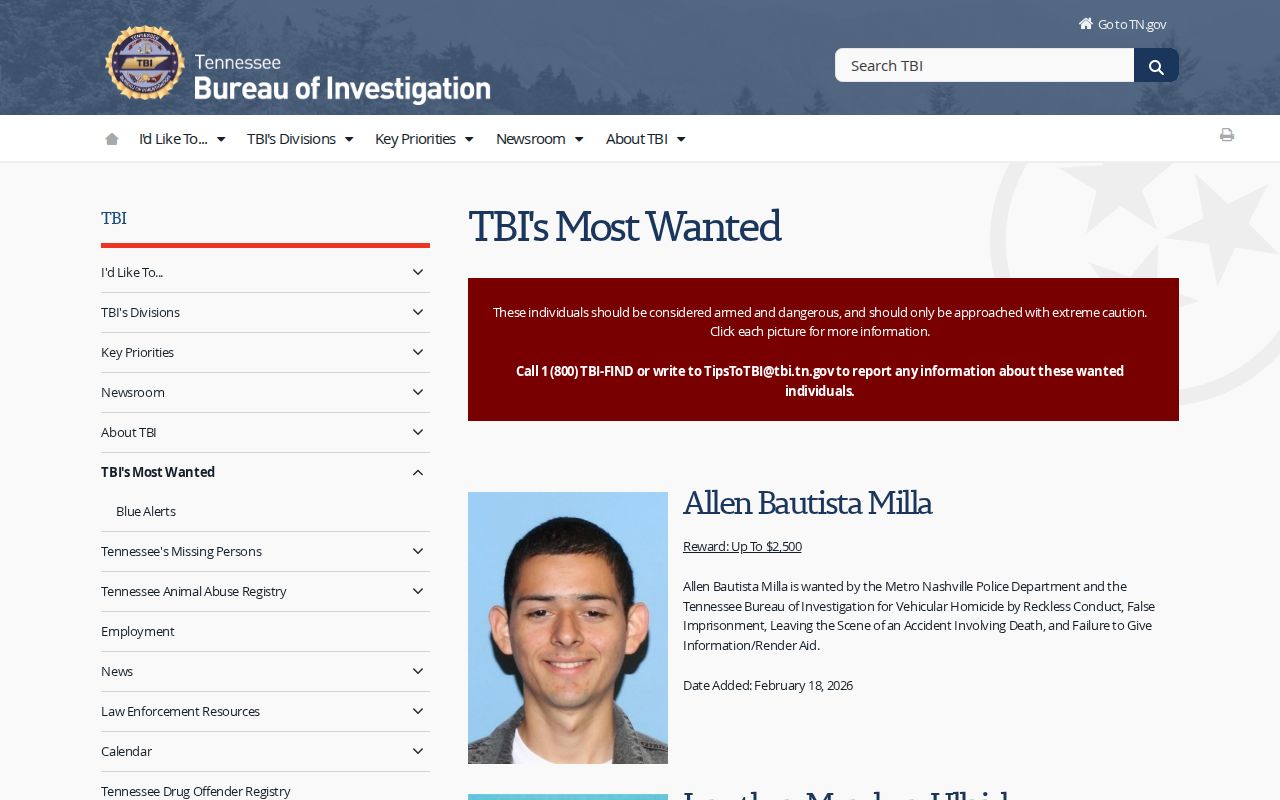
The screenshot identifies the statewide program; it is not a Claiborne roster or proof of a local case status.
Claiborne County Has No Local Roster
The local sheriff’s public site provides office, dispatch, and jail contacts but no dedicated warrant unit, public active-warrant list, or county most-wanted feed. The county’s official sources reviewed likewise did not identify an amnesty roundup. Treat those as limits of the published material, not proof that no warrant or enforcement action exists.
For an individual record, contact the court that issued the process or ask the Sheriff’s Office whether it can direct a service question. The Claiborne County Sheriff’s contact page supplies office and 24-hour routing numbers, not a warrant-status result.
Claiborne Cases Must Meet TBI Criteria
TBI’s published rules require a Tennessee violent-felony or major drug-trafficking case and an identified person with an arrest warrant on file; specified escape circumstances are also listed as eligibility routes. A director or designee must approve an addition. Those standards make the program selective, not a complete statewide warrant roster.
TBI’s criteria section describes program eligibility. A Claiborne case does not appear there merely because a warrant exists.
How the TBI Most Wanted List Works
TBI describes a selection process for cases submitted by an agent or law-enforcement official and sets eligibility criteria for the program. The list is a curated statewide set, not a complete collection of Tennessee warrants. A person may leave the display after law enforcement updates the case, but the TBI page does not replace confirmation from the court that issued the underlying process.
Note: The list is a program snapshot; an entry or its absence cannot confirm current Claiborne County warrant status. Use the issuing court for that answer.
Claiborne Tips Reach the TBI Program
TBI accepts public information by its toll-free line and online submission form. Its tip page says a person may remain anonymous, while contact details can help an investigator follow up. Tips that lead to a capture may qualify for reward money; eligibility and amount depend on the case and should never be promised in advance.
The official TBI tip page explains the available channels. The image shows tip guidance, not a local reward notice.
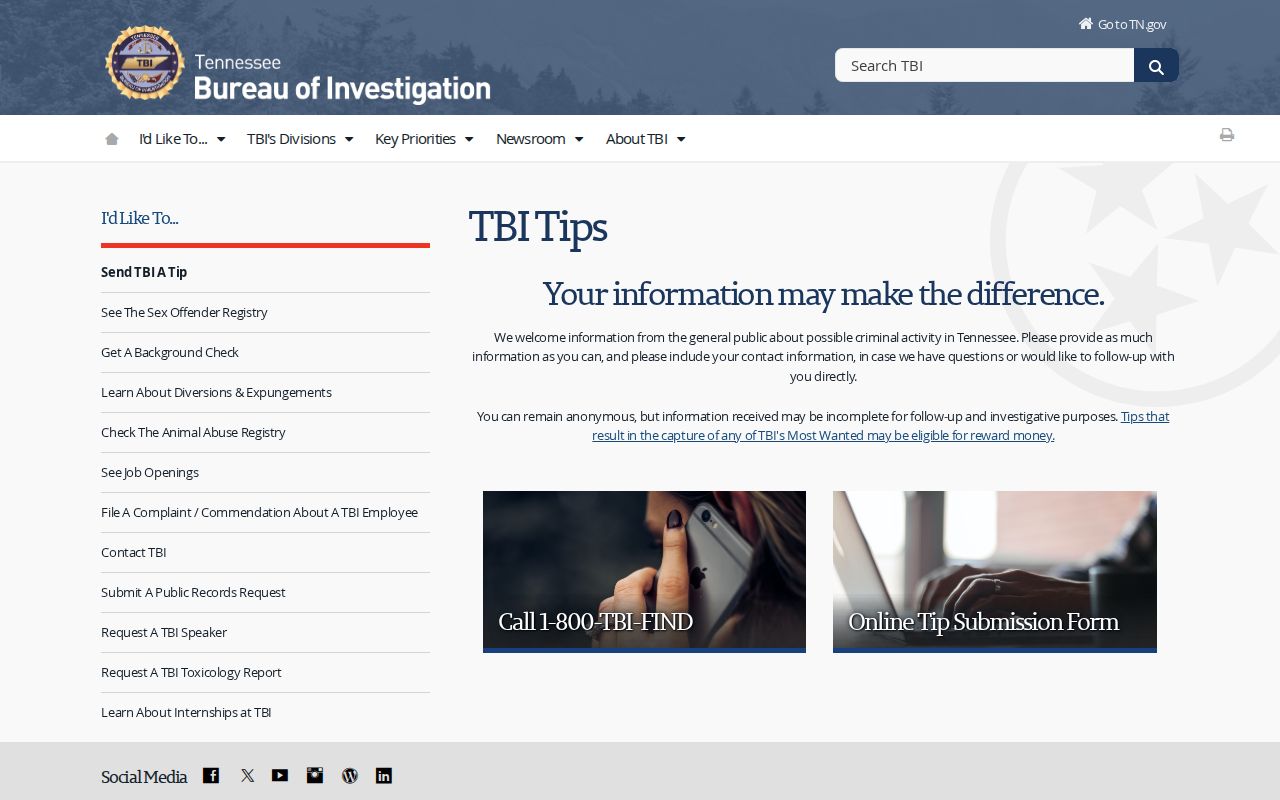
Give factual information through an official channel and let investigators handle contact or follow-up.
How to Report a Tip Safely
For a TBI-listed case, report information through 1-800-TBI-FIND, the online form, or TipsToTBI@tbi.tn.gov. Give the location and facts you know, and ask the receiving agency how to reference any follow-up. You do not need to approach or detain anyone to report information.
- Use TBI’s official phone or online tip route, or call the federal task-force number for a task-force fugitive tip.
- Describe what you observed, where, and when; share only what you know firsthand.
- Do not confront, follow, or detain anyone. Move to a safe place and let law enforcement respond.
- If you seek anonymity or want to ask about a possible reward, confirm the agency’s process when submitting the tip.
Key Point: TBI says anonymous tips are accepted, and some tips may qualify for a reward. Eligibility varies; report and step back rather than approaching anyone.
Claiborne Federal Tips Reach the Marshals
The U.S. Marshals Service Eastern District of Tennessee identifies the Smoky Mountains Fugitive Task Force as serving Claiborne County. Its published tip line is 1-888-869-4589; that task-force route is separate from a county clerk’s court-record inquiry. For immediate danger, use emergency services.
The Marshals’ task-force directory explains the federal fugitive program. The image represents federal court information, not a local wanted bulletin.
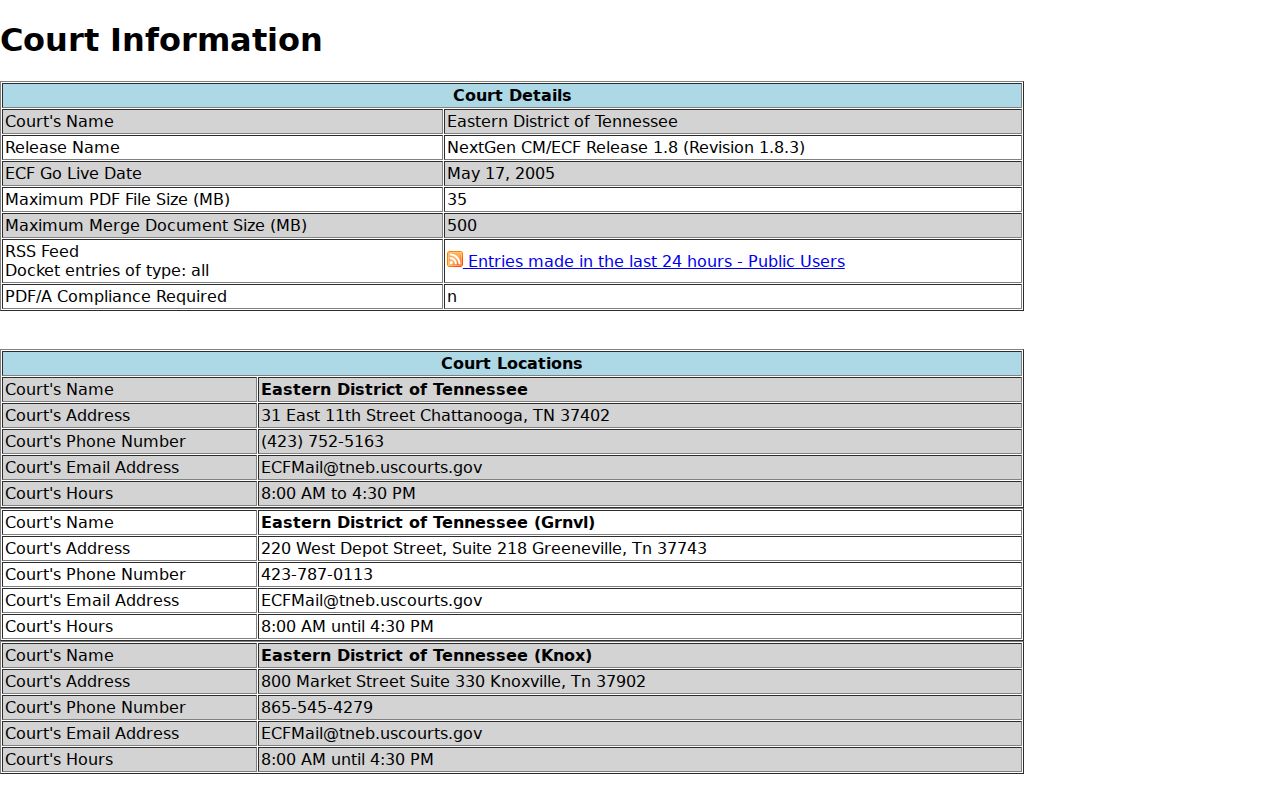
Keep federal and state court references separate when you call an agency.
Most Wanted vs an Active Warrant
Most Wanted status is a publicity decision for a selected fugitive case, not a separate warrant type. Many outstanding warrants never appear in TBI’s Top 10. Conversely, a page entry is not a complete docket history and cannot establish that a particular court process remains unserved.
| Feature | Most Wanted List | Active Warrant |
|---|---|---|
| Scope | Selected statewide fugitive cases meeting TBI criteria | A case-specific court process that may not be published online |
| Who maintains it | TBI program staff and submitting law-enforcement agencies | The issuing court and law-enforcement records custodian |
| Public visibility | Only the cases the program chooses to display | Access depends on the court record and applicable restrictions |
| How to resolve | Confirm with the responsible agency and court | Ask the issuing court for the approved next step |
Claiborne Federal Warrants Use PACER
A federal matter is checked through federal court records, not a Tennessee municipal ticket tool. Under the current PACER schedule, electronic access costs ten cents per page, most documents are capped at three dollars, and quarterly charges of thirty dollars or less are waived. PACER has announced a twelve-cent page rate and forty-dollar waiver threshold beginning January 1, 2027; check the current pricing page and its fee-change notice before a later search.
PACER’s official site provides account access and fee details. The image demonstrates a federal docket context only; it does not show a Claiborne County warrant record.
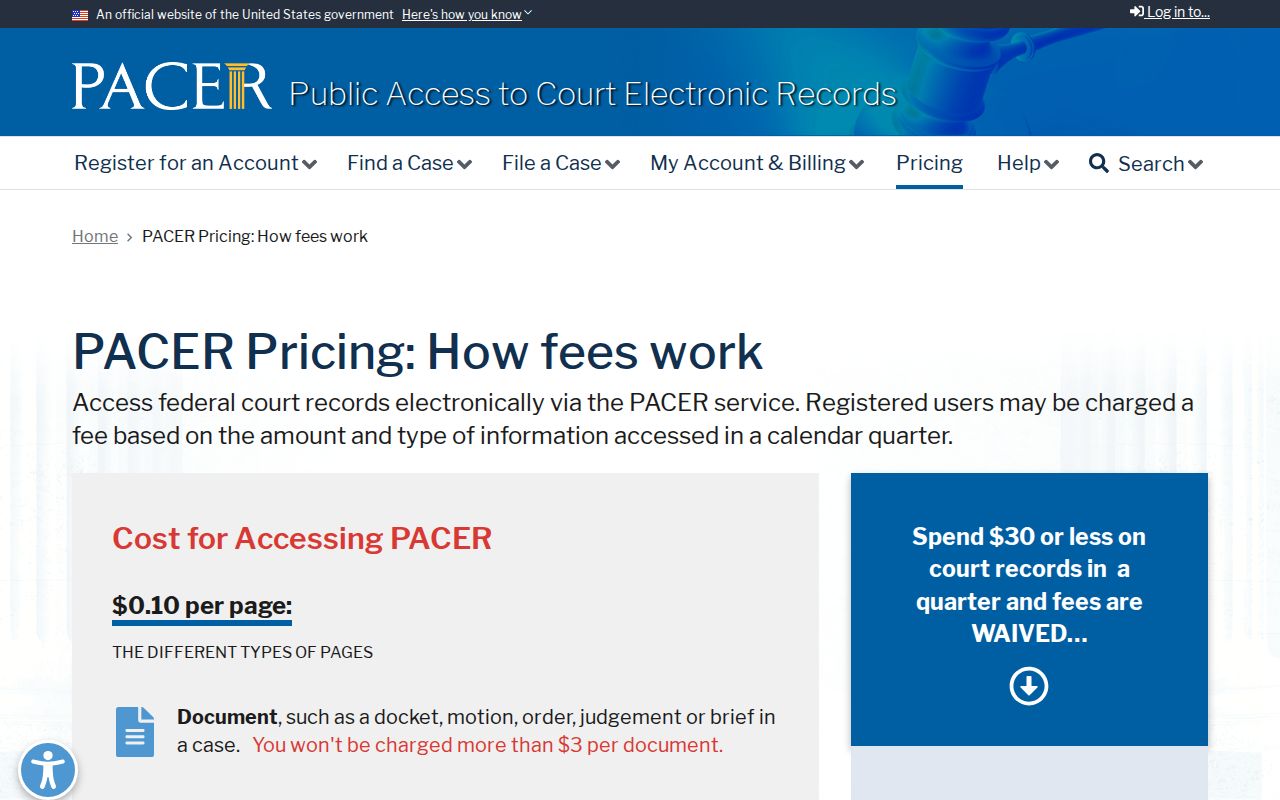
If you are unsure which court issued process, use the court name on the paperwork before searching.
If You Believe You Are on a List
If you believe a warrant may exist, contact the court or ask a lawyer to confirm the record and advise about an appearance or surrender. A sheriff contact can explain whether it handles service or custody routing; it cannot replace the issuing court’s instructions. Keep the court, case number, and any written direction for your records.
Important: Do not rely on a public list alone. Ask the issuing court or counsel to confirm status and the approved next step before traveling.